
486 Days on Duolingo - An Honest Review From the Top 1%

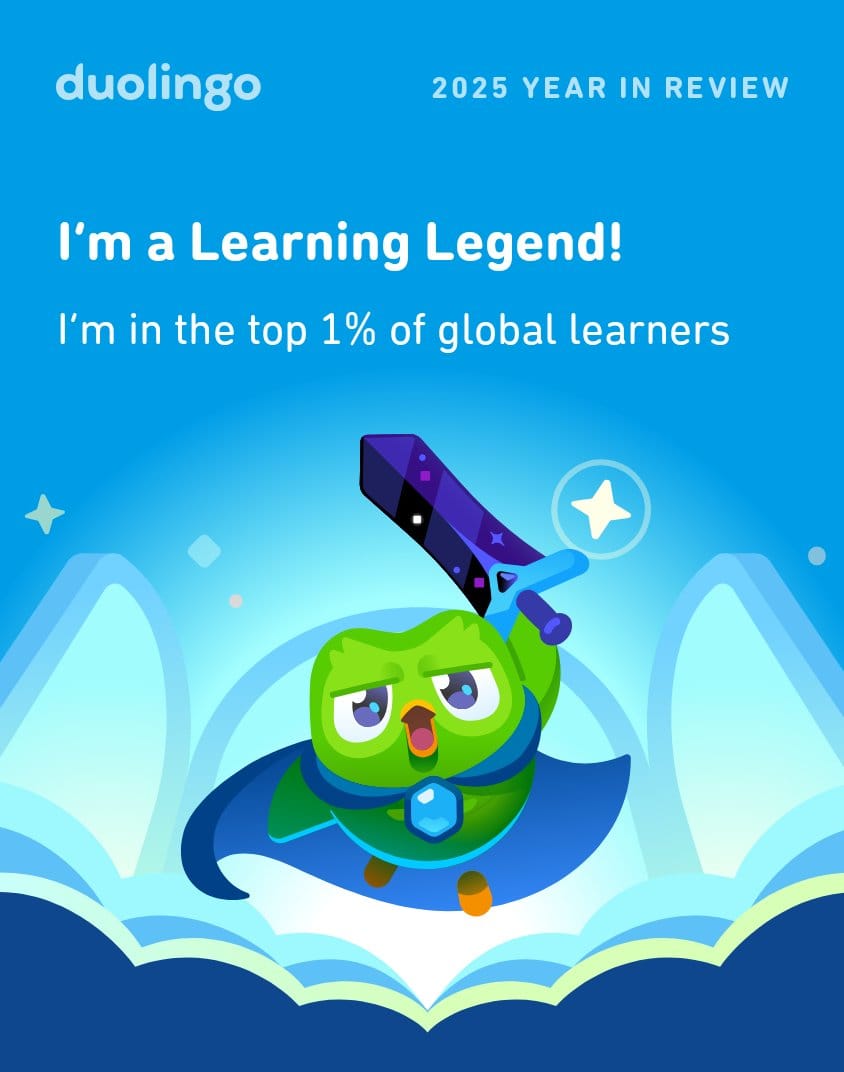
I've been using Duolingo every single day for the past 486 days. That kind of commitment puts me in the top 1% of global learners on the platform, which means I've earned the right to write one of the most honest reviews you'll find about this app. No affiliate links, no sponsored bias. Just 486 days of streaks and a complicated relationship with a green owl who won't let me breathe if I so much as think about skipping a day.
Let's get into it.
The Pros
1. It's Built Around One of the Most Powerful Ideas in Self-Improvement
Duolingo's entire foundation rests on commitment and the daily habit. And if you've ever studied productivity or high performance, you've probably seen this elegant little formula floating around:
(1.00)³⁶⁵ = 1.00
Doing nothing changes nothing
(1.01)³⁶⁵ = 37.78
1% better every day compounds into something extraordinary
That's exactly what Duolingo is betting on. It doesn't promise overnight fluency. It promises that if you show up every day, even for ten minutes, the results will stack. And they do. The app even lets you share streaks with friends if you're learning together, turning a personal habit into a social commitment. Accountability, gamified.
2. The Mascots Are Genuinely Delightful
I know this sounds like a minor detail, but it's not. The characters on Duolingo are funny, distinct, and surprisingly charming. And here's something people don't talk about enough: through these mascots, you get exposed to a real variety of voices (male, female, young, old) which is invaluable for building listening comprehension.
My personal favorite? Lily. The sarcastic, purple haired goth who visibly cannot believe you got that answer wrong again. She's iconic!

3. It Understands the Science of Memory Better Than Most Classrooms Do
This is where Duolingo genuinely impresses me as a learner.
The app is built around what's known as the Forgetting Curve, a concept introduced by German psychologist Hermann Ebbinghaus. The idea is simple but profound: our memory of new information decays rapidly over time unless we actively revisit it. In fact, the speed of forgetting depends on the difficulty of the material, how meaningful it is to us, and even external factors like stress and sleep.

The antidote? Spaced Repetition. Instead of cramming, you revisit material at increasing intervals. Day 1, Day 3, Day 7, and so on, effectively interrupting the forgetting curve each time, until the knowledge settles into your long term memory. Duolingo does this quietly in the background, nudging you to review what you're starting to forget before it's too late. Most people use the app without realizing the cognitive science baked into it. And that's good design.
4. The Ranking System That Will Ruin Your Weekends (In the Best Way)
Let me explain how this works, because it's genuinely brilliant, and slightly diabolical.
Duolingo has 10 leagues in total, from lowest to highest: Bronze, Silver, Gold, Sapphire, Ruby, Emerald, Amethyst, Pearl, Obsidian, and Diamond. Each week, you're placed in a group of learners and you compete by earning XP (experience points) through completing lessons. The top learners get promoted to a higher league the following week, and the bottom performers get demoted.
The Diamond League is the pinnacle of the system, reaching it means you've demonstrated a remarkable level of dedication and consistency. And staying there is a different story altogether. XP requirements vary wildly depending on how competitive your group is, some Diamond League groups require 10,000+ XP just to stay competitive.
I'll be honest with you: staying in the Diamond League stops being a casual thing very quickly. It becomes a life-or-death situation.
5. It Covers Everything: Reading, Listening, Writing, Speaking
This isn't a flashcard app. Duolingo hits all four pillars of language learning within a single session. And once you reach an intermediate level, the Stories feature unlocks, short narrative dialogues that mimic real-life situations you might actually face. I find them genuinely insightful, and they're a significant step up from isolated sentence drills.
6. They're Pushing the Boundaries With AI
Recently, Duolingo introduced the "Call with Lily" feature, an AI powered conversation partner. It's as close as the app gets to simulating a real conversation with a native speaker, and it's impressive. The gap between language app and real world practice has never been narrower, and Duolingo is actively closing it.
7. The CEFR Integration Is a Stroke of Genius
This one genuinely excited me. During a recent DuoCon, Duolingo announced a collaboration with the CEFR system (Common European Framework of Reference for Languages), the internationally recognized standard for language proficiency. The app now offers a score that maps to CEFR levels (A1 through C2), and you can share it directly on LinkedIn.
8. The Language Library Is Massive
Duolingo offers a huge range of languages, and importantly, lets you learn them from your native language, which is the most natural and effective way to acquire vocabulary. I'll let you guess which language I've been using it for.
9. Yes, There's Also Math, Music, and Chess
Duolingo has quietly expanded beyond languages. Math courses, music lessons, and even Chess, all taught in the same gamified format. Honestly, it's becoming less of a language app and more of a habit building platform for curious people.
The Cons
I genuinely regret having to write this section. Duolingo is one of my favorite apps in the world, and I don't say that lightly as someone who is particularly selective about the technology I invest my time in. But honesty demands it.
1. The Bugs After the AI Update Are Infuriating
When Duolingo rolled out its major AI powered updates, the lessons changed, which is expected and understandable. What is not acceptable is what came with it: a wave of persistent, demoralizing bugs.
Here's what I've personally experienced:
- Daily Quests not counting lessons or study time correctly
- XP bonuses disappearing without reason
- Audio cutting out mid exercise during listening tasks
- Completed lessons reverting back to "incomplete"
This is more than an annoyance. When your league position depends on XP tracking and your Daily Quests are silently broken, you're being penalized for work you've genuinely completed. It's unjust, and when you're competing in the Diamond League, it's the kind of thing that makes you want to send a strongly worded email to someone's CEO. At this point, I've exhausted the in app options. Reaching out directly to the team on LinkedIn feels like the next logical step, and I'm genuinely considering it.
2. The Support Team Has Essentially Ghosted Me
For an app whose entire model is built on competition and fairness, the customer support experience is a contradiction. Despite reporting these bugs repeatedly, through in app feedback and multiple emails over several months, I have received zero response. Not a form email. Not an automated acknowledgment. Nothing.
If your product's core loop is "earn XP fairly and compete," then a broken XP tracker isn't a minor bug. It's a fundamental breach of the user experience.
3. The Competitive Features Can Work Against Actual Learning
Here's the paradox at the heart of Duolingo's design, and I say this as someone who has fallen into this trap myself: when you're chasing league position, you stop asking "what do I need to learn?" and start asking "which exercise gives me the most XP?"
Those are not the same question.
- The daily streak quietly becomes a chain: the longer it gets, the more you fear breaking it, and that fear can become a stronger motivator than the actual desire to learn.
- The league system, brilliant as it is, rewards XP farming over genuine practice of weak areas.
The Honest Summary
Duolingo is, in my opinion as a polyglot, the best app available for learning languages in a fun and interactive way. But its value depends on who you are and why you're learning.
- Beginners and casual learners: Duolingo is perfect. It's low pressure, surprisingly deep, and will take you further than you expect.
- Learning for professional or academic purposes: Use Duolingo as a supplementary layer, a fun way to anchor and review what you're learning elsewhere. Don't make it your primary resource.
- Advanced learners: Your time is better spent reading posts like this one, listening to podcasts in the target language, watching native content, mimicking characters from films and series, and, most importantly, speaking with natives.
If you want me to write a follow-up on how I specifically use Duolingo as part of a broader language learning system, or a deeper dive into language learning in general, let me know through my contact page or on social media.